

React will outlast us
I've been writing React code for almost a decade now. I've seen every cycle of panic, backlash, and "React is dead" prediction - honestly, it made me tired (even the recent React2Shell).
But we've hit an inflection point, and it has nothing to do with the new Activity component or the long-awaited React Compiler.
It has everything to do with how AI writes and scaffolds our apps.
I'm here to say: React didn't just become the default choice. It became the statistical default in the training data of every major coding model.
And now, it won't just be hard to dethrone - it will be practically impossible without changing how AI models learn and generate code.
Why React dominated before 2024?
People usually point to the same three reasons:
- Ecosystem - React has a very large community (a subreddit with almost 200k people) and a near-infinite amount of companion libraries and meta-frameworks (from component libraries to state management, Next.js, and many more).
- Job market - The job market favors React engineers in somewhat of a vicious cycle: companies are looking for React engineers because they build apps with React, and the cycle goes on where bootcamps only teach React.
- The Component Model - React wasn't necessarily the simplest, but it was the first to successfully standardize the "Component" mental model in a way that scaled for large teams.
But, in 2024, something else happened.
AI and The "Vibe Coding" Era
The AI shift started with GitHub Copilot in 2021: autocomplete, but smarter.
Three years later, in November 2024, a small company called Lovable launched something different - an application generator.
This kickstarted the era that Andrej Karpathy would later coin as "vibe coding" .
That moment changed everything for React, because AI agents suddenly became its most enthusiastic evangelists.
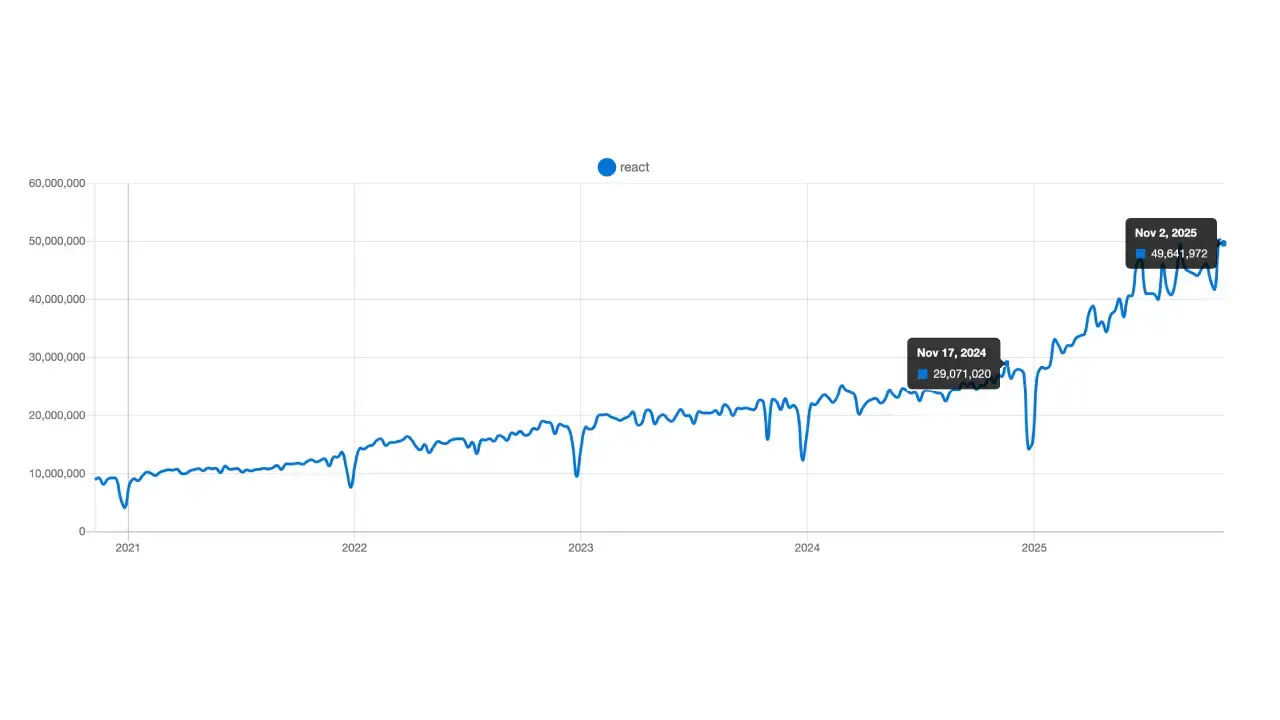
After Lovable's launch (and similar tools like Base44, Bolt, and v0), React's weekly downloads on npm almost doubled.
Correlation isn't causation, but it lines up uncomfortably well with the moment AI tools started defaulting to React for everything.
I know, npm numbers may be inflated by CI/CD, but the trend is real: React is now approaching 50M downloads per week.
Lovable say they picked React because:
React is the most widely adopted front-end library, with a vast developer community and extensive third-party support. This means that almost any UI challenge can be solved using existing React packages, saving time and effort in development.
Sure - expected. Then comes the more important line:
large language models (LLMs) trained on code repositories can generate high-quality React code due to its dominance in online resources.
It's clearly visible when looking at these tools' system prompts: Lovable , v0 , Bolt , That's the real story.
LLMs favor React for the same reason humans do: repetition at scale.
Let's play a little game. I tried the following prompt in ChatGPT, Gemini, and Claude: "Generate a UI for a todo app." Want to guess how many of them used React?
You're right, 3/3 - all three models defaulted to React as the framework of choice. None of them chose Angular, Vue, Svelte, or plain HTML and JS.
The underlying data matches this:
- State of JS 2024 : React at 82% usage; Vue and Angular far behind (51%, 50%).
- StackOverflow: ~477k React questions; ~300k Angular; ~100k Vue; ~6k Svelte.
- GitHub dependents: React ~29.8M; Angular ~4M; Svelte ~0.4M.
Those numbers aren't just popularity metrics. They're a mirror for what LLMs see over and over again when they learn how to code. There's just no way to undo that.
The Momentum Problem
Every new framework (hello Remix 3.0 👋) faces an impossible barrier:
LLMs won't default to tools that don't already have massive adoption. And they can't reach massive adoption without LLM amplification.
You can nudge models with better prompts, tools, and context, and some frameworks are already doing that.
But that's an uphill battle against years of React-heavy training data and examples baked into the models themselves.
For example, here's a quote taken from Reddit in regards to Svelte 5:
Most of them still don't get Svelte 5. … they either spit out old Svelte … or mess up the new syntax completely.
I know, you can enrich context with MCP (Context7) or tool-specific docs, but that only gets you so far. It doesn't change the underlying training-weight reality: React occupies far more of the internet's code corpus than anything else.
React isn't going anywhere. Not because it's perfect, or because the team made all the right calls - but because AI locked it into a feedback loop that compounds faster than competitors can realistically catch up.
The uncomfortable truth is that future frontend decisions won't be made by teams alone. They'll be pre-decided by whatever the models are best at generating - and today, that's React.
If you have any questions or want to continue this debate, feel free to comment here or reach out on X .
Thank you for reading,
Matan.